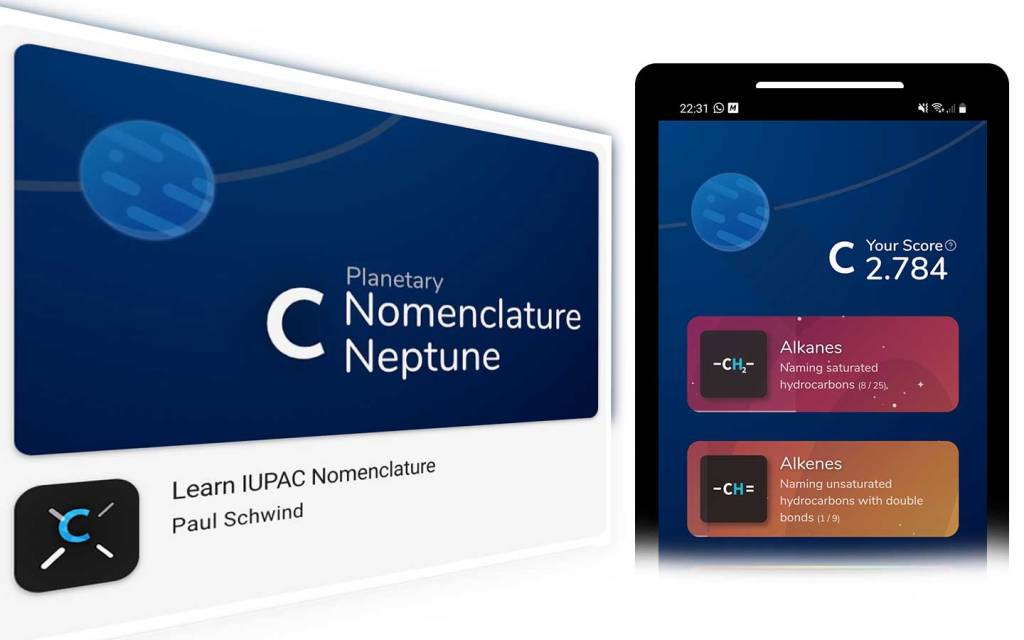
Learn IUPAC Nomenclature, also known as Nomenclature Neptune, is one of the rare useful apps for students because it combines brief theoretical insights with hands-on practice, making it feel like you are experiencing organic chemistry firsthand. A playful and educational app, it is free at basic levels, with additional levels and premium content, available for Android and iOS.
I want to tell you about an app I discovered by chance while scouring the app stores. I was looking for something useful to practice a subject that has always been elusive for me: Chemistry.
More specifically, the app I’m talking about focuses on organic chemistry and its fundamentals: hydrocarbons and some of the main functional groups.
Although it doesn’t cover a vast amount of content, you’ll find that it has aspects that make it remarkable for its ability to quickly convey the mechanisms of organic chemistry.
You will immediately put into practice the principles that govern compounds. This is a fundamental aspect for truly grasping the concepts! In no time, you’ll feel like you are mastering the basics of organic chemistry, a realm of chemistry that often intimidates and discourages those faced with hydrocarbons and other strange compounds.
The app is called Nomenclature Neptune (also found under the name ‘Learn IUPAC Nomenclature‘) and is available for both Android and Apple iOS devices. The developer of the app is Paul Schwind, who has also created other educational applications.
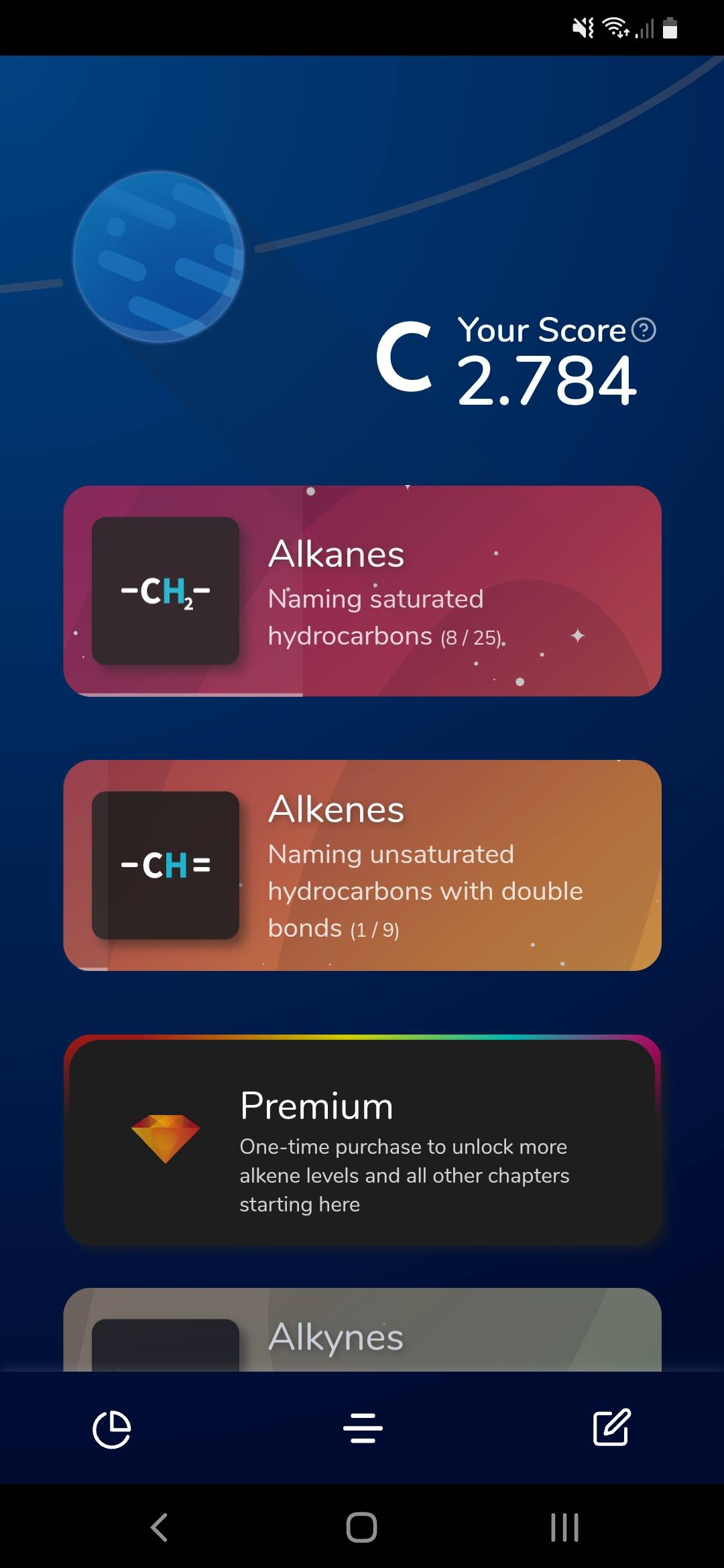
I would say that the ‘formula’ – to stay within the realm of chemistry! – of Nomenclature Neptune follows the freemium model: it is free for the initial levels, which include the basic organic compounds, and then if you want to unlock all subsequent levels – with their respective molecules – it requires a one-time purchase of $3.99. Thus, a very modest price if you want to access all the features.
Why I find it excellent
This app is smart because it embodies the prototype of active learning. To truly understand and assimilate a concept, it’s not enough to just read the theoretical information and leave it at that. No, you have to try it out! And this is even more true for chemistry, an experimental laboratory science.
If it remains confined to books and memorized theories, it will always be difficult to grasp.
On the contrary, it is better understood when put into practice. In fact, among my friends and acquaintances who have studied chemistry and work as chemists or researchers in the field, I have always noticed their ability to speak very concretely about chemical phenomena, often referring to their laboratory experiences or very real applications.
But that’s another story.
I was saying, Nomenclature Neptune starts with the initial organic compounds. So, the basic level covers alkanes, hydrocarbons that, as we know, have the empirical formula CnH(2n+2).
At each level, a brief tutorial welcomes us, explaining how with Nomenclature Neptune we can easily construct organic molecules using a practical notation with sticks and letters, allowing us to compose on our smartphone screen a kind of structural formula for molecules.

This aspect is truly intuitive, as the user simply needs to add carbon atoms and bonds (sticks), while hydrogen atoms are added or removed automatically by the program.
Ah, I forgot to mention, the app is in English (and German is also available from the app’s internal menu), but for students and enthusiasts of scientific subjects, English (the international language of science) shouldn’t be a problem.
An example
From level to level, we are asked to construct certain molecules. For example, I’ve reached a fairly basic level in the first step, focusing on alkanes, where the screen prompts me with the request: ‘build: ethane’.
Then I drag a carbon, and on the screen appears the first C, bonded to 4 Hs. I draw a line, and automatically another C is added, with the system adjusting the number of hydrogens: the formula appears as CH3––CH3. I say okay, and… I’ve entered the correct formula; the app tells me, ‘You fend off the meteorite!’
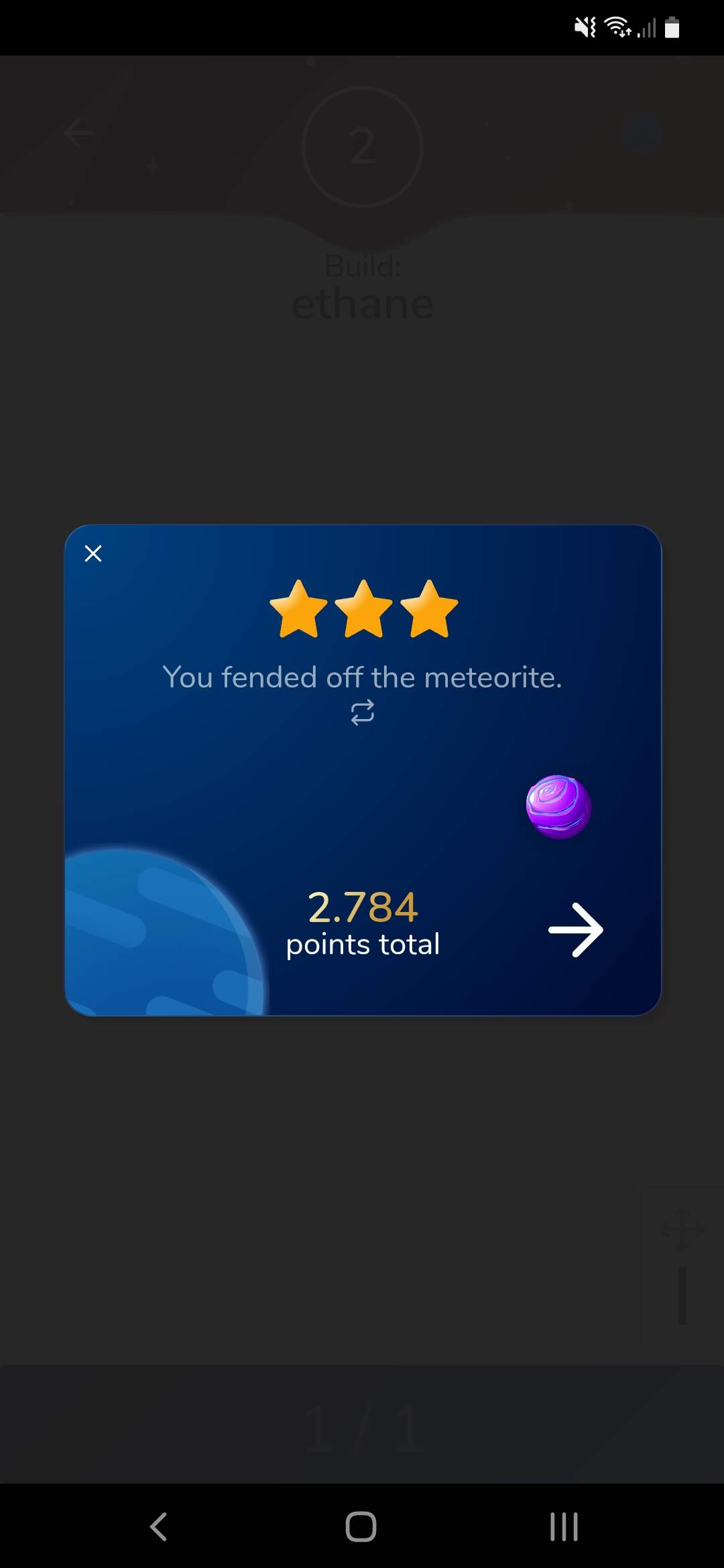
For each completed mission, points are accumulated, and the app’s playful aspect revolves around the imaginary defense of Neptune from hypothetical meteorites: if I solve the exercise well, I’ve defeated the threatening wandering rock and earn points.
Let’s try Level 2 together: alkenes
Alkenes, also known as olefins, are unsaturated hydrocarbons containing one or more double bonds between carbon atoms, in addition to single bonds. As shown in the informative screen at the beginning of the level in Nomenclature Neptune (these cards are pleasant and useful nuggets of theory, to be read carefully!), here’s an example of alkenes with a double bond C=C.

Moreover, Nomenclature Neptune also explains how to understand the numbering of the various carbon atoms: ‘The main chain is numbered so that the position of the double bond is as low as possible’.
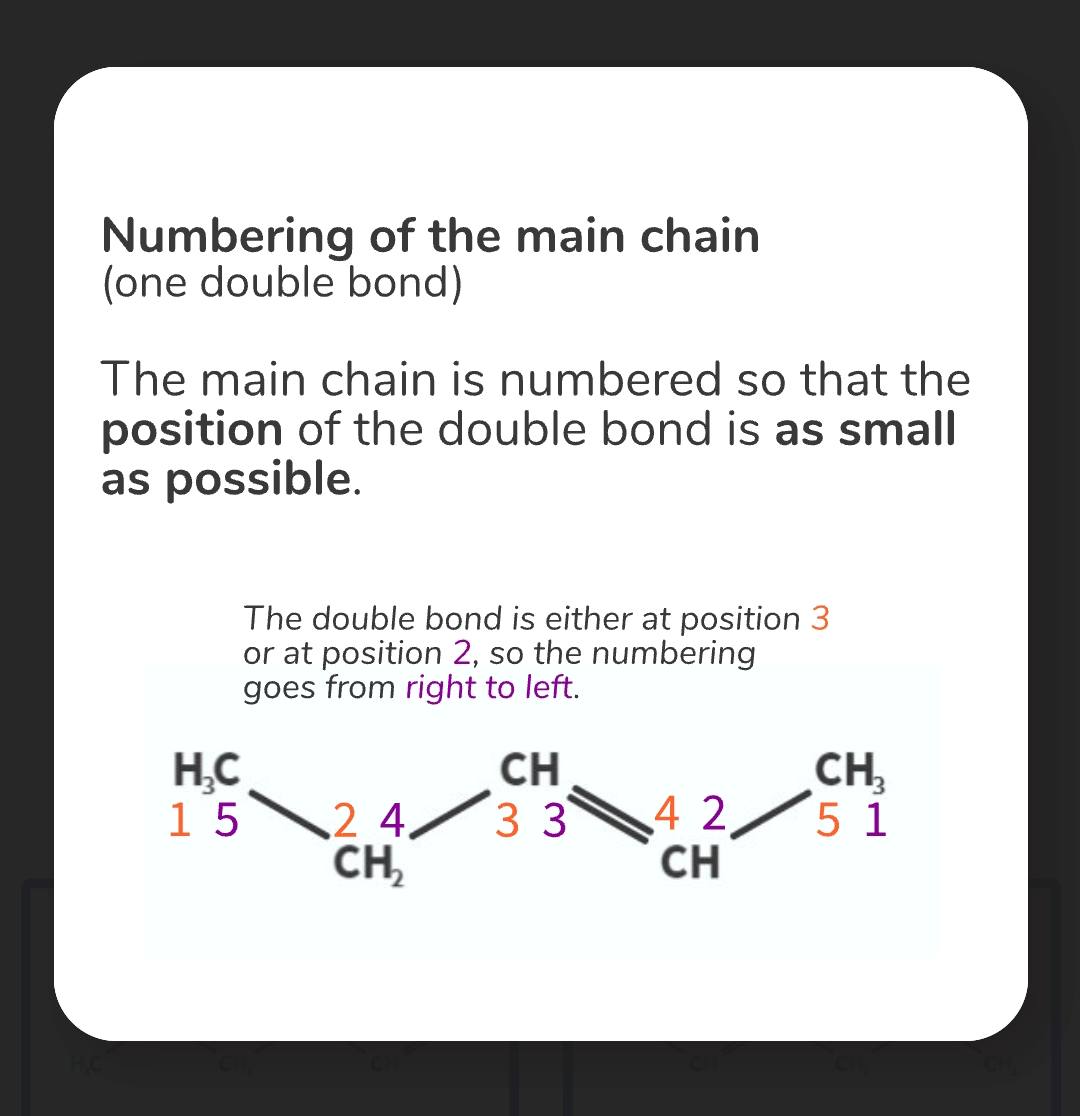
So, multiple-choice quizzes are presented where we have to identify the correct name or the correct structural formula of the alkene presented.
Let’s see… but-2-ene… I would say it’s an alkene with 4 carbon atoms (alkenes, unlike alkanes that end in -ane, have the ending -ene, so here ‘but-‘ automatically makes me think of butane, which has 4 carbon atoms; the alkene but-ene will therefore have 4 carbon atoms). The double bond will then be on the carbon in position 2: Correct!

Alternatively, we are given a structural formula, and we have to indicate which of the four options is correct, meaning which is the correct name given to that molecule.

In this case, it is indeed a pentene (pent-1-ene).
A promising app
Nomenclature Neptune is, in my opinion, very well-made. It allows us to become familiar with organic chemistry, almost letting us experience firsthand how hydrocarbons are structured.
There’s also a small environment for freely constructing organic molecules, a sort of whiteboard where we can write and erase as we wish, creating molecules by adding carbon atoms and other elements (though to access the full range of elements, one needs to unlock the premium version). At the top row, the software tells us the name of the chemical chimera we’re assembling, as we add atoms and bonds.
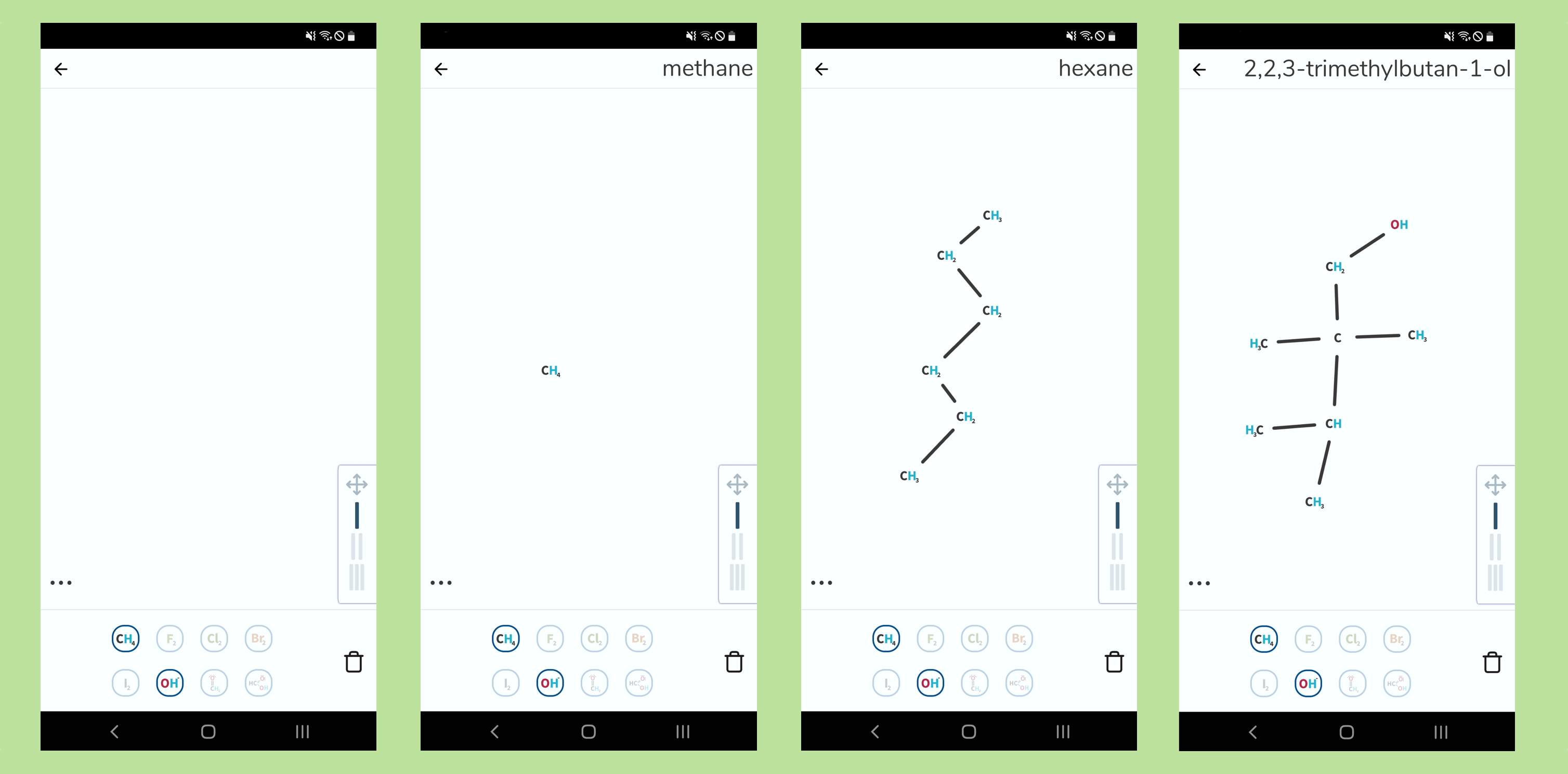
Having tried this app also allows me to reflect on the potential of such software. Useful study applications and games are becoming increasingly rare, especially those as practical and functional as this one, which is also thankfully free from intrusive advertisements. In my opinion, Nomenclature Neptune deserves to have wide distribution.
Undoubtedly, it could be further improved to make it an even more comprehensive educational app.
An improvement I would suggest is to emphasize the gamification aspect and scores, making it almost a small social platform for organic chemistry! Even a simple leaderboard or scoreboard to display scores of other players worldwide would be great. It could create small challenges between friends and acquaintances.
In addition, while the modest price to unlock all features is admirable, it would be nice to have the opportunity to try more free levels before committing to a purchase. I would also expand the content with many more topics and insights into organic chemistry. In my opinion, these enhancements would only increase the appeal of this small yet useful app.
An added benefit would also be translation into other languages.
In any case, my compliments to the developer.
Try Nomenclature Neptune! (Note: you can also find it on the stores under the name ‘Learn IUPAC Nomenclature‘):
 FilosofoMed
Lascia un commento